“ANTI…” is a compelling visual treatise on temporal dissolution and the formation of a New Mythology.
Operating at the liminal intersection of Surrealism and Pop Aesthetics, the collection presents canvases that dismantle the linearity of time and place.
The core narrative is one of union: a gravity-defying synthesis of the sacred, the natural, and the extraterrestrial. Nature is not backdrop but protagonist—its inhabitants elevated to totemic status, embodying instinct and divinity.
With wry humor and contemporary irony, the work critiques modern fashion and cultural archetypes. Together, the pieces form a cosmic continuum, where past and future dissolve into a single, lucid reality.
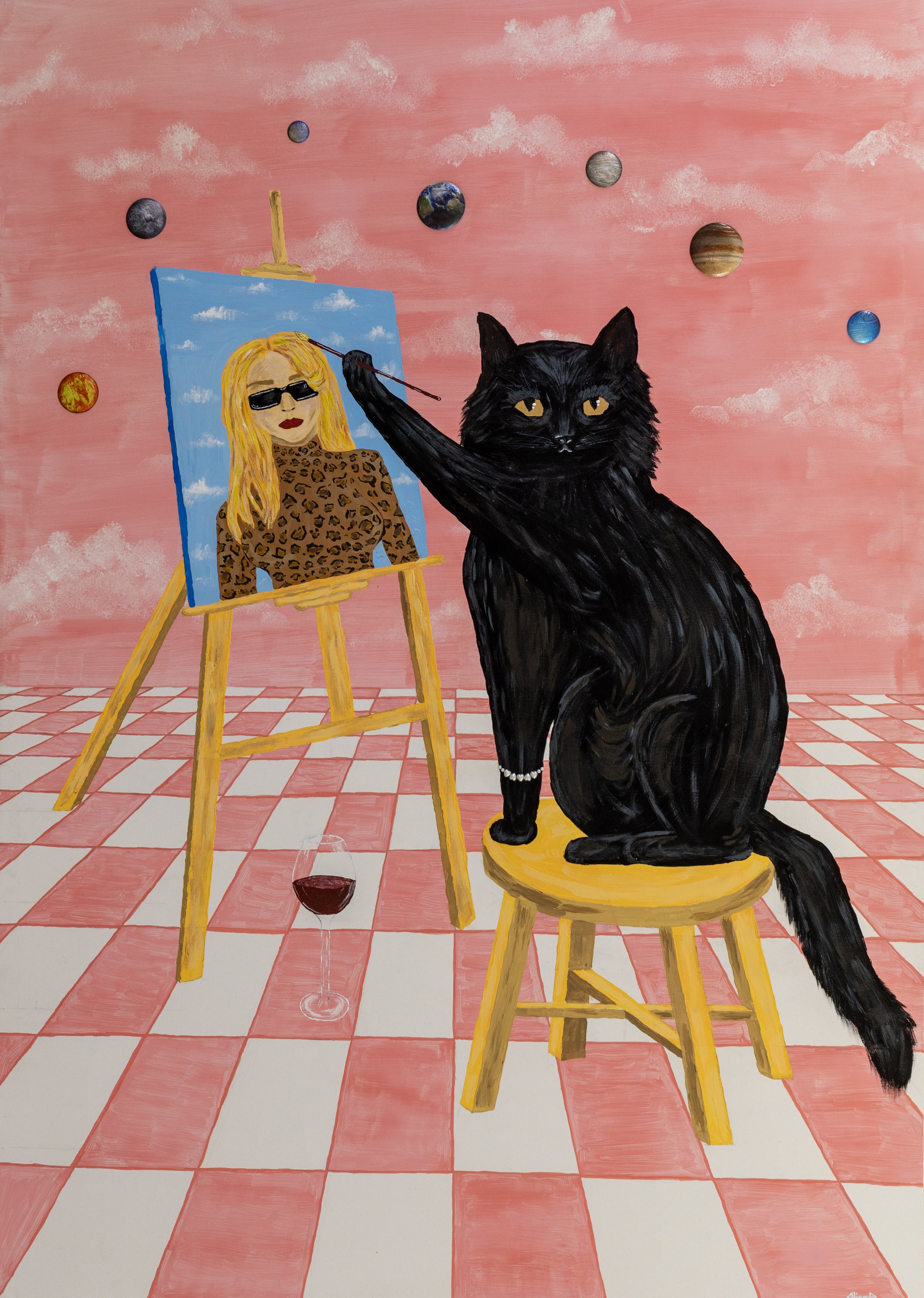
Kubrick and Me Acrylic on canvas, 170 × 120 cm A surreal dialogue on authorship and perception. Kubrick and Me stages a psychological mirror between creator and creation — a question of who observes whom. At first glance, a woman paints a cat. Yet, through the cat’s unwavering gaze, the act reverses: perhaps the cat paints the woman. Serving as the artist’s alter ego, the cat embodies feminine creative force — intuition, independence, and mischief — while the woman becomes both subject and observer. This ironic self-portrait comments on image, vanity, and the performative act of self-representation. The “painting within the painting” transforms into a hall of mirrors, where identity and authorship continually reflect and distort one another — a cinematic meditation worthy of its title.
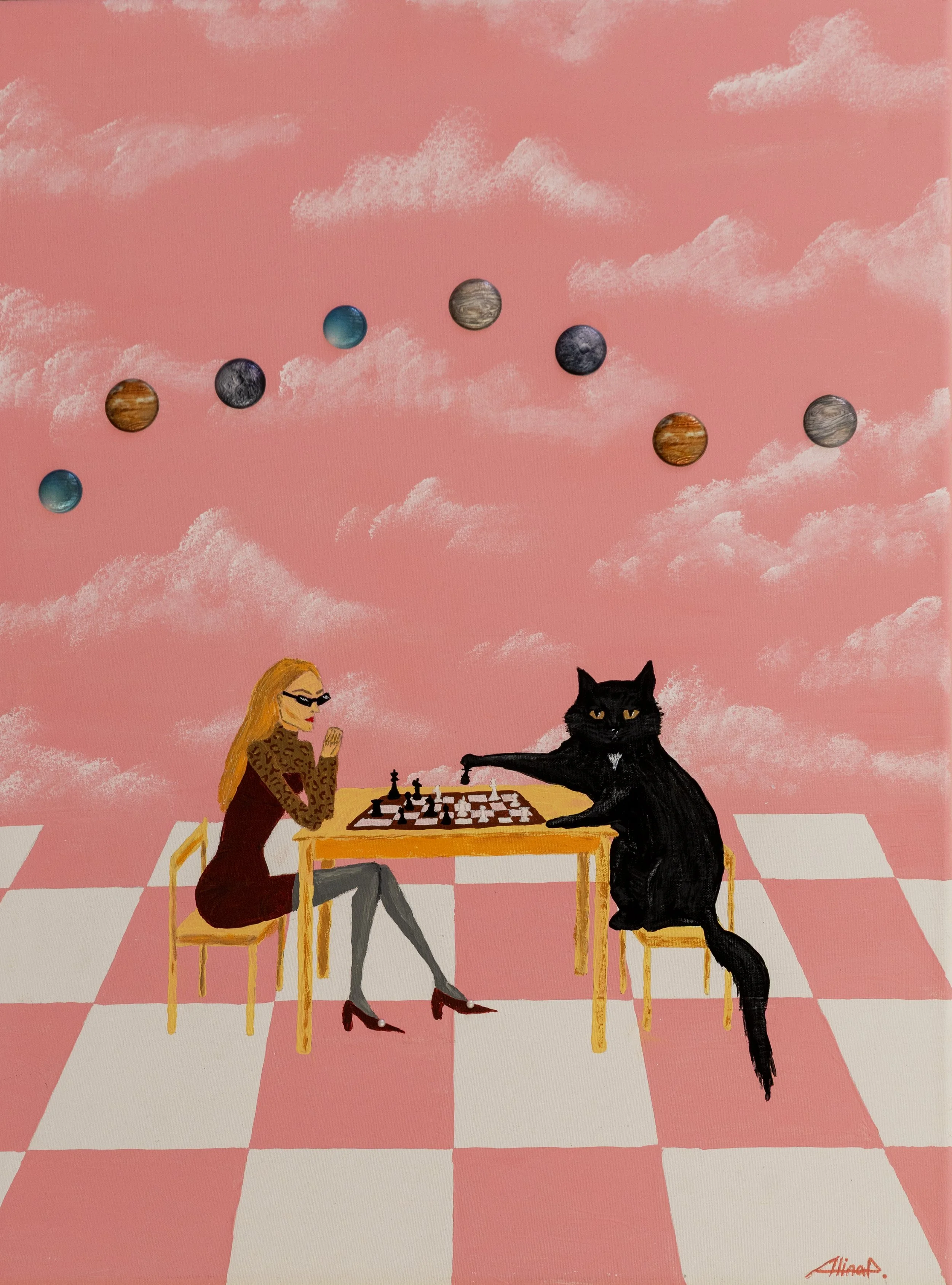
Kubrick’s Checkmate Acrylic on canvas, 60 × 80 cm Merging neo-psychedelic, surrealist, and pop aesthetics, Kubrick’s Checkmate unfolds as a humorous yet existential meditation on power, instinct, and duality. The chessboard becomes an allegory of confrontation and destiny—each move an irreversible decision, each gesture a quiet act of defiance. The woman embodies consciousness, control, and calculated reason; the cat, her intuitive double, personifies the unruly subconscious that resists all order. Their silent duel blurs logic and emotion, intellect and instinct—light and shadow in constant negotiation. The soft pink, cosmic background subverts the tension of strategy, transforming the board into a field of intimacy rather than conflict. Here, checkmate is not defeat but the delicate balance of love and surrender.
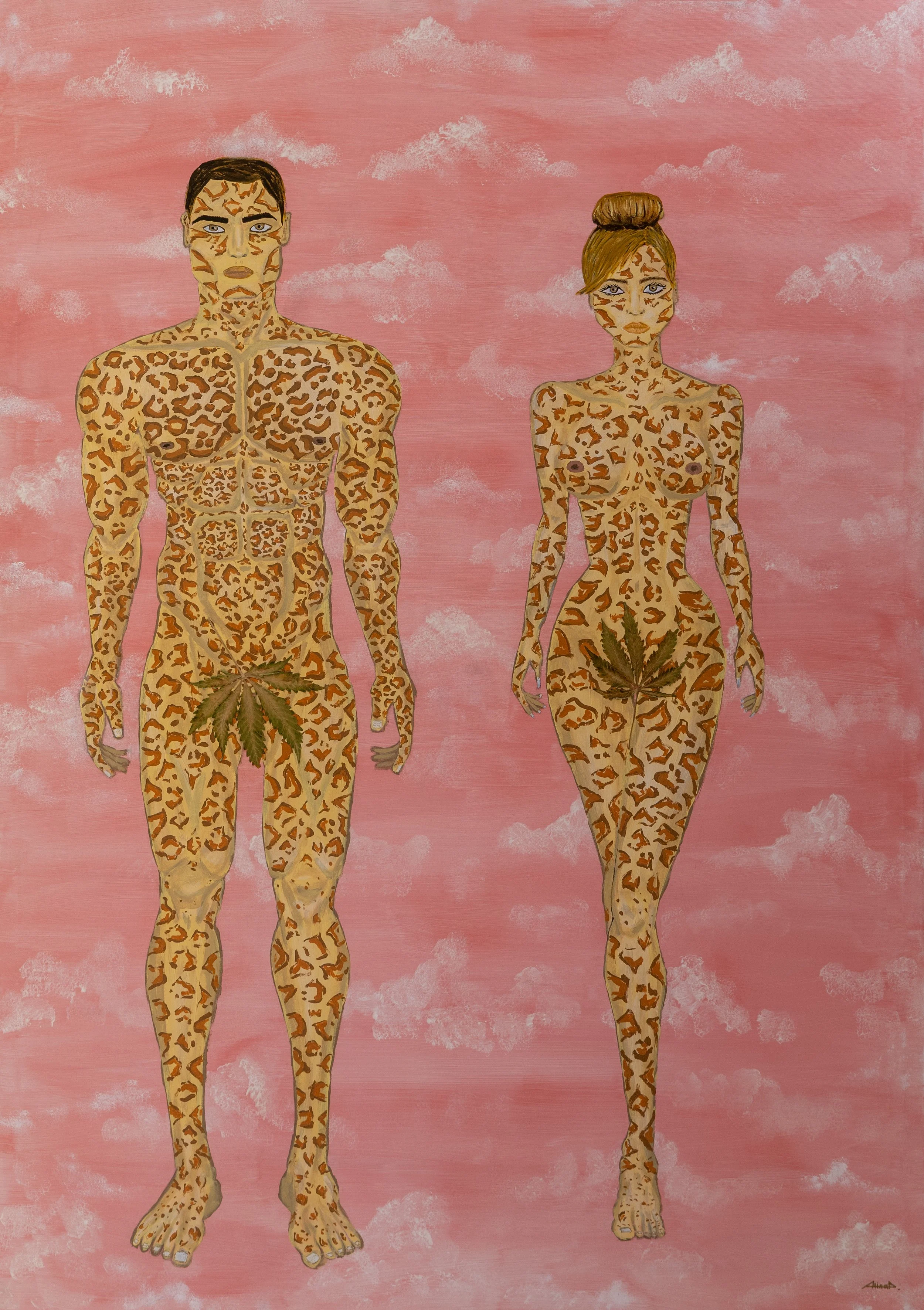
New Era Acrylic on canvas, 170 × 120 cm Infused with Pop-Art flair and postmodern surrealism, New Era reimagines the archetype of Adam and Eve through a contemporary, ironic lens. The leopard motif functions as a symbolic skin, merging animal and human into a single hybrid body — a tension between instinct and civilization, desire and decorum. On the surface, it evokes fashion’s fascination with the exotic; beneath, it critiques the cultural machinery that molds humanity into artificial ideals of perfection. Replacing the classical fig leaf with a cannabis leaf, Puzanova performs a bold act of visual rebellion — a humorous yet liberating gesture that reframes the myth of guilty nakedness into one of freedom, resistance, and unapologetic pleasure.
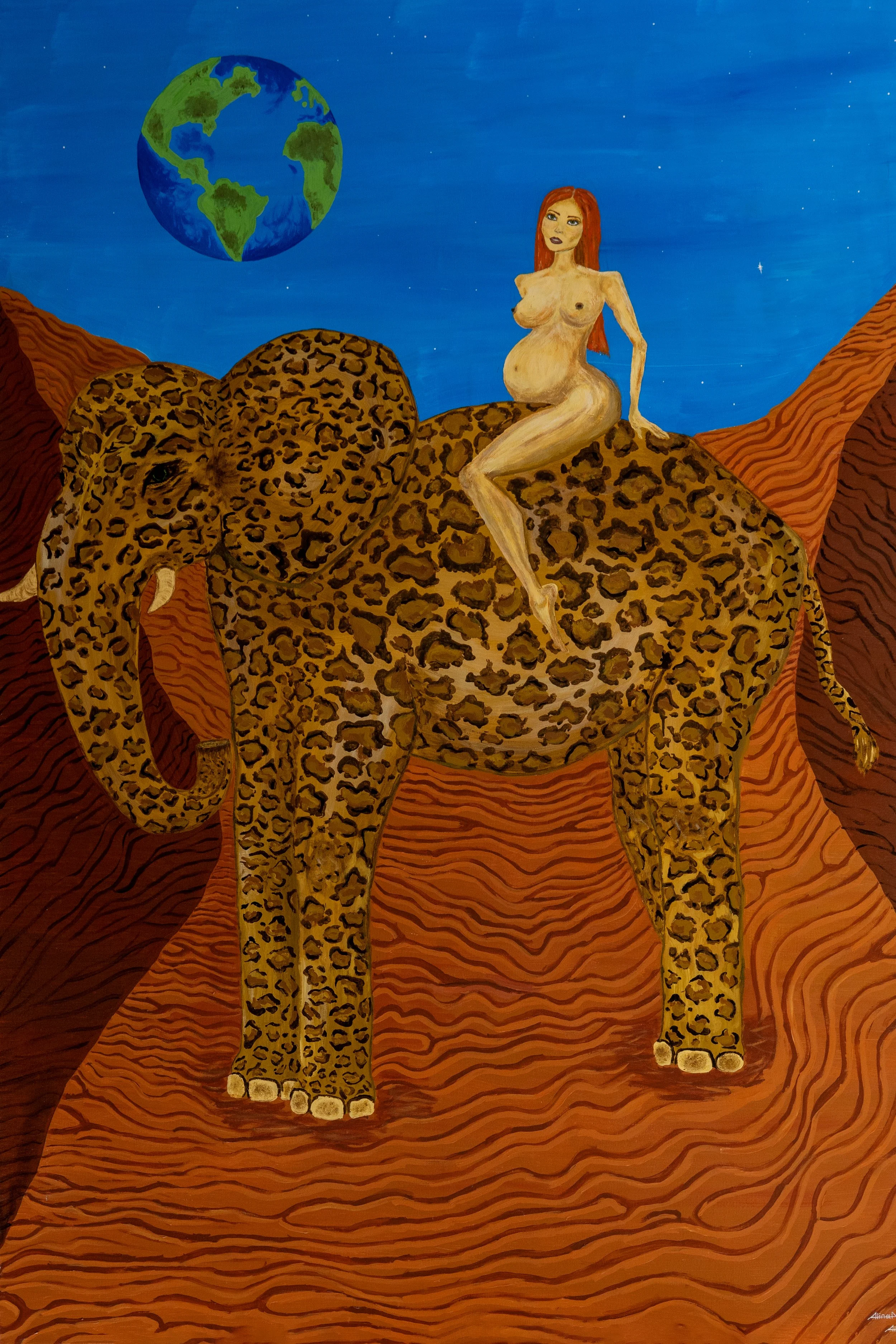
Genesis Acrylic on canvas, 190 × 130 cm A vision suspended between dream and divinity, Genesis unfolds within a surreal universe where natural laws dissolve and symbolism reigns. At its center, a woman appears in Madonna-like serenity, embodying fertility, continuity, and the inception of life—a new genesis on a new planet. Humanity and nature merge into a single organism, initiating a renewed cycle of creation. The elephant, monumental yet tender, bears on its skin the imprints of the jungle—memories of an ancient life that never fades. In Buddhist tradition, the elephant evokes Ganesha, deity of wisdom, prosperity, and auspicious beginnings, protector of travelers and thresholds. Through this union of myth and matter, Genesis envisions rebirth not as a singular event but as a perpetual rhythm of becoming, where instinct and divinity share the same breath.
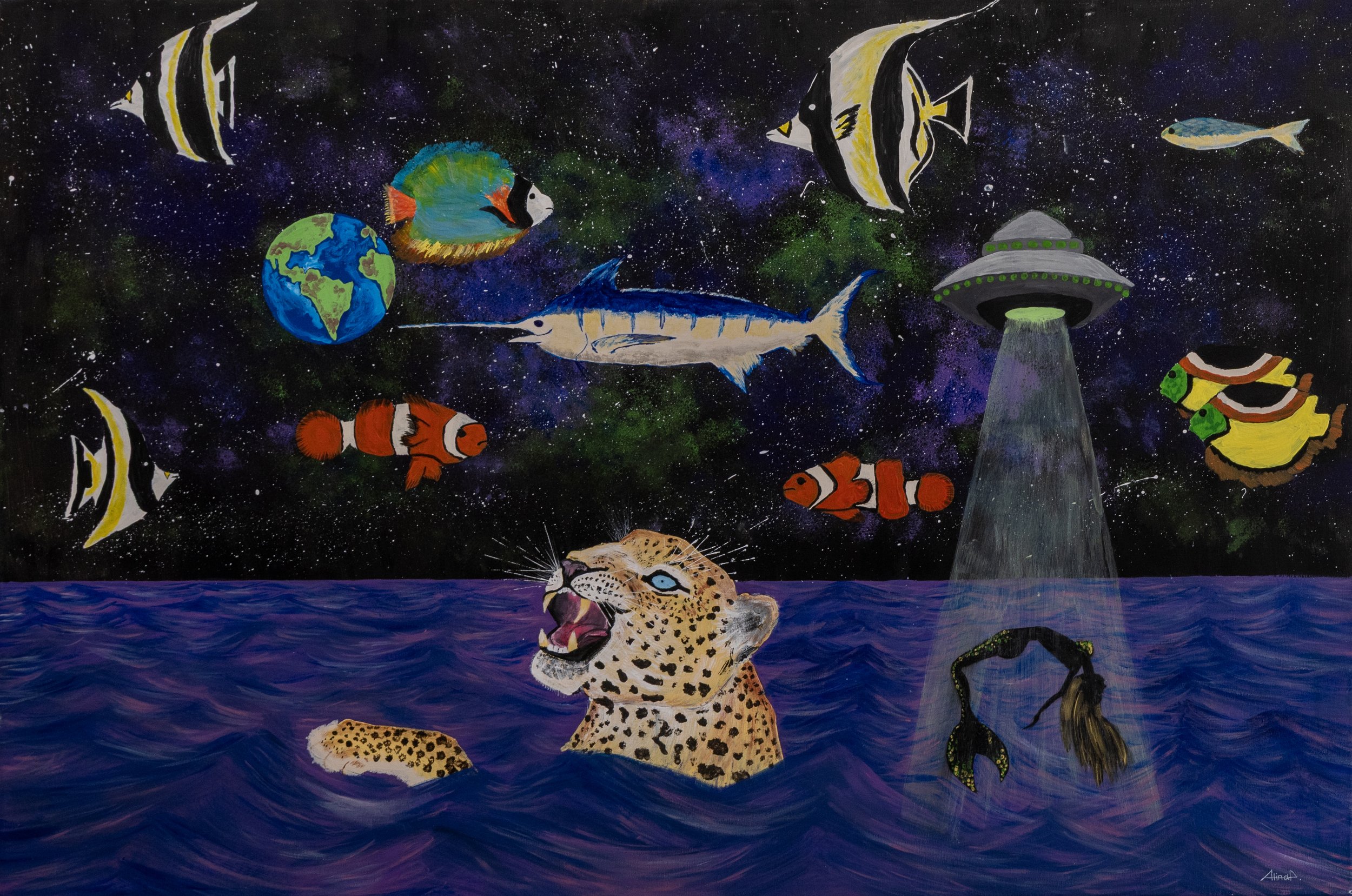
Anti… Acrylic on canvas, 150 × 100 cm At once pop-surrealist and mythological, Anti… envisions the interconnectedness of all worlds—natural, astral, and imaginary. Earth, adrift among fish, becomes just another planet suspended in an aquarium: a new creation myth for the post-human age. The leopard, a symbol of instinct and strength, inhabits an environment alien to its nature, embodying adaptation, survival, and inner struggle. Nearby, a mermaid crowned with a UFO emerges as a sign of technological transcendence and extraterrestrial intervention—a moment of initiation toward a new evolutionary threshold. The fish, floating freely through cosmic space, signify the dawn of a new ecosystem where species dissolve the boundaries of matter and time. Across ancient traditions—from the Christian ἰχθύς (Ichthys), a symbol of salvation and rebirth, to Vishnu’s divine fish Matsya—the motif recurs as a vessel of redemption, divine guidance, and continuity between myth and modernity. Here, the aquarium becomes both cradle and cosmos—an image of creation, captivity, and the eternal cycle of becoming.
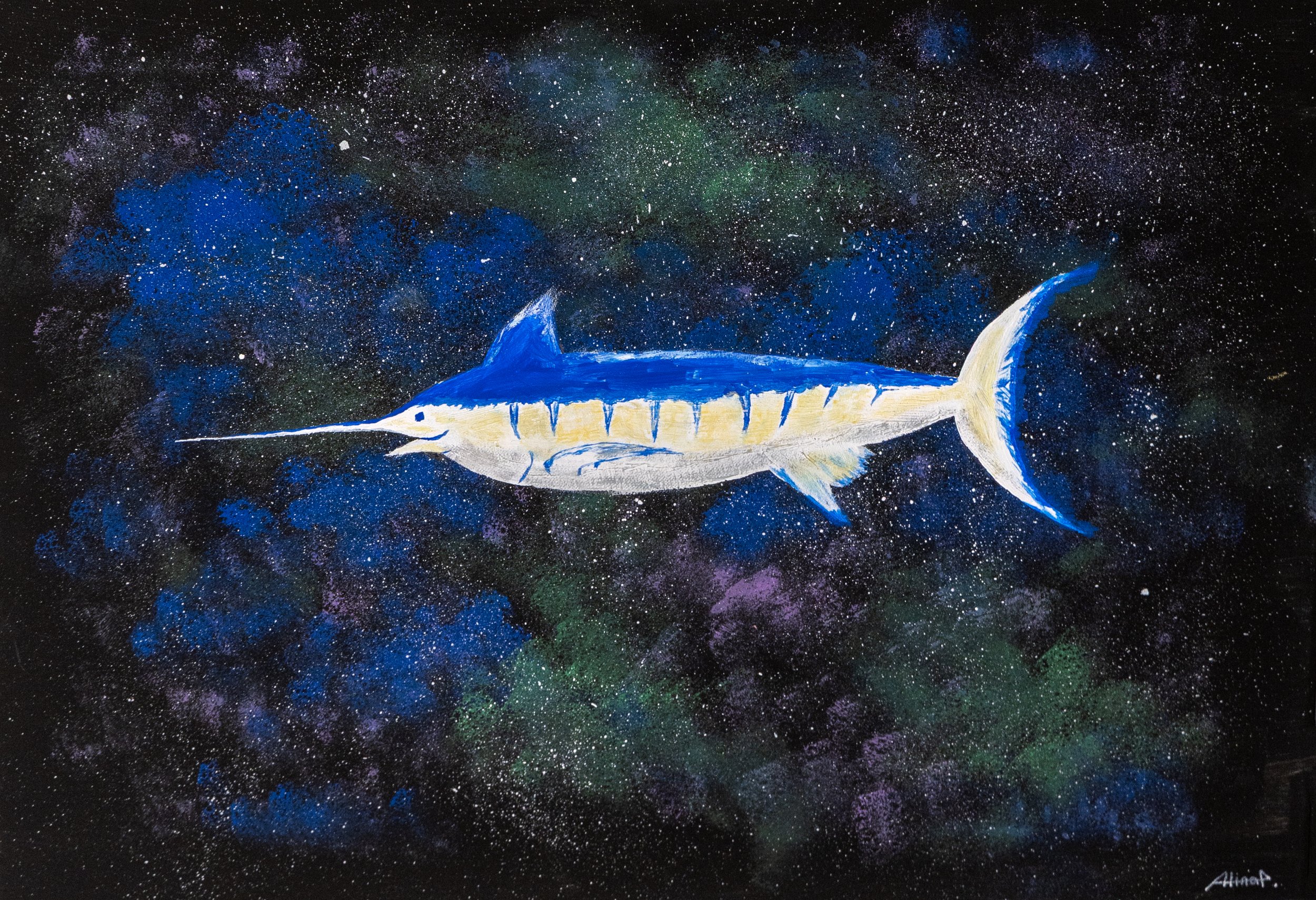
Our Universe Acrylic on canvas, 70 × 50 cm In a vision shaped by pop surrealism and mythic cosmology, Our Universe imagines a new ecosystem—one that transcends species, gravity, and time. Suspended in the vastness of space, the fish drift freely as emissaries of transformation, bridging the natural, astral, and imaginary worlds. They inhabit a post-human continuum where creation expands beyond material form, suggesting evolution as a fluid, ever-renewing process. Across ancient traditions, the fish emerges as a sacred archetype of salvation and rebirth—from the early Christian ἰχθύς (Ichthys), emblem of divine deliverance, to Vishnu’s incarnation as Matsya, the savior of a world engulfed by flood. In this cosmic sea, the motif becomes universal: a vessel of memory, guidance, and perpetual return.
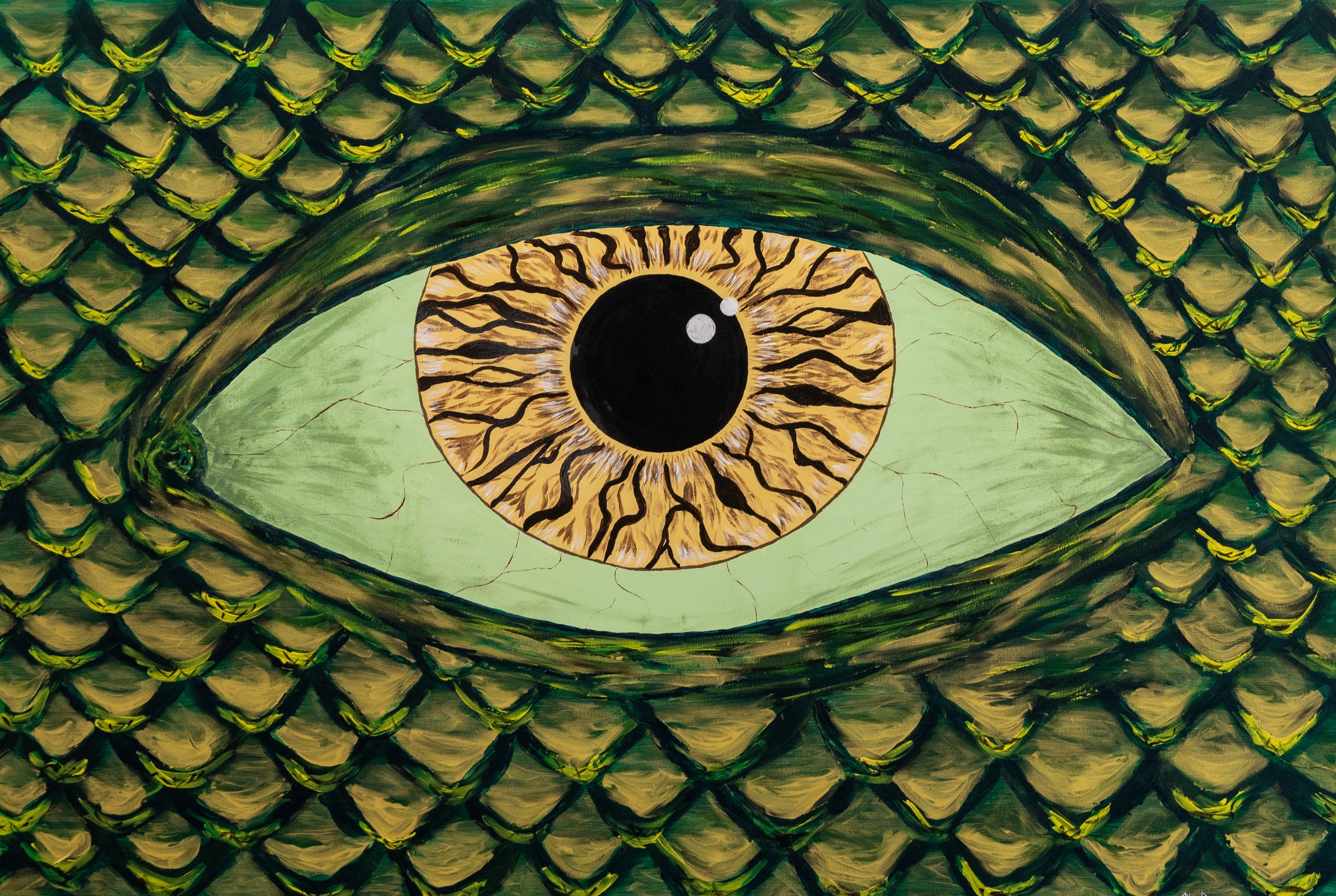
The 3rd Acrylic on canvas, 150 × 100 cm A metaphorical mirror between being and observer, The 3rd captures the fleeting instant when perception reverses — when the viewer realizes they, too, are being seen. The single, unblinking eye becomes both witness and oracle, embodying the Ajna Chakra, the “third eye” of Eastern philosophy: the seat of intuition and higher consciousness. It alludes to an awareness that transcends the physical — the capacity to see beyond appearances and to perceive the invisible architecture of existence. In this silent exchange, the canvas no longer depicts but participates. The viewer and the being merge in mutual recognition, dissolving the line between observation and awakening.
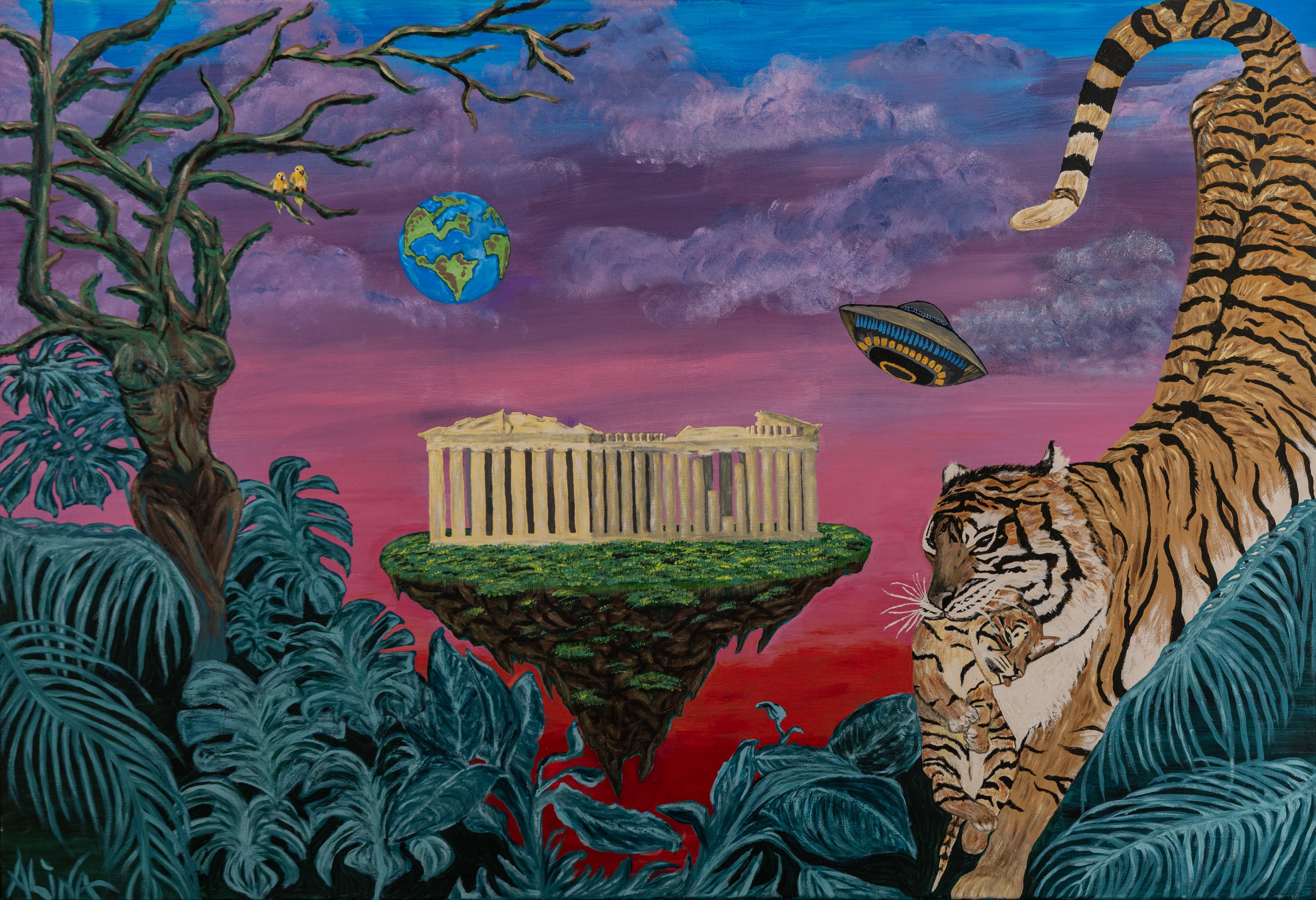
The Day After Tomorrow Acrylic on canvas, 190 × 130 cm In a post-cataclysmic dreamscape, The Day After Tomorrow imagines the Earth’s most beautiful creations suspended in quiet survival. Ancient architecture, animal life, feminine archetype, and cosmic technology converge in a fragile equilibrium — the world’s “next day.” The Parthenon stands as a relic of lost civilization; the tiger and her cub embody strength, instinct, and rebirth. The female figure fused with the tree emerges as Mother Nature herself — rooted yet eternal, a conduit between earth and sky. Above, the UFO hovers like a new divinity, a symbol of technological transcendence and the evolution of faith. It asks: if gods once created humankind, do we now create our own gods through invention? The green island, adrift in the cosmic dark, becomes the final remnant of memory — the seed of a world beginning again. Through this synthesis of ancient and futuristic, The Day After Tomorrow envisions a universe where collapse and creation are inseparable, and where even after the end, the mother gives birth again.
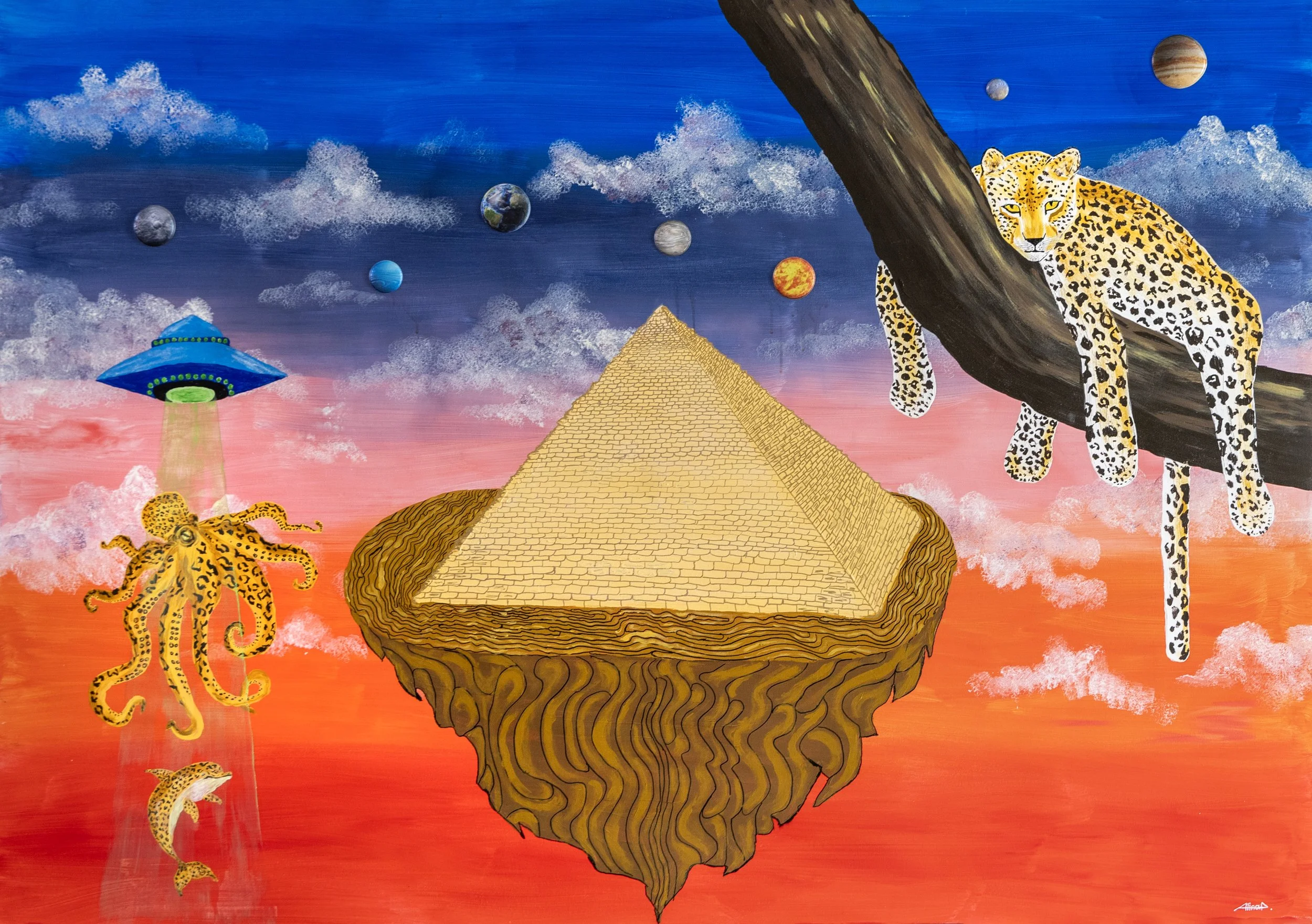
The Day After Tomorrow II Acrylic on canvas, 170 × 120 cm A surreal vision after a great flood, The Day After Tomorrow II expands the mythic landscape of its predecessor into a meta-cosmic continuum. Here, antiquity and science fiction collapse into a single symbolic language — a dialogue between ancient wisdom and future technology. The UFO and planetary orbits become celestial hieroglyphs of a new faith. The octopus, fluid and intelligent, embodies adaptability and mystery, while its leopard-patterned skin unites water and land, mammal and mollusk, the earthly and the extraterrestrial. The leopard stands as guardian and guide — a deity of instinct, independence, and feminine power. The dolphin, conversely, represents emotional intelligence and harmony, bridging water and air, emotion and logic. In Greek mythology, dolphins have long symbolized salvation and divine protection; even Apollo is said to have taken their form to guide humankind to knowledge. Together, these symbols chart a vision of survival and renewal — a world reborn through synthesis, intelligence, and balance.
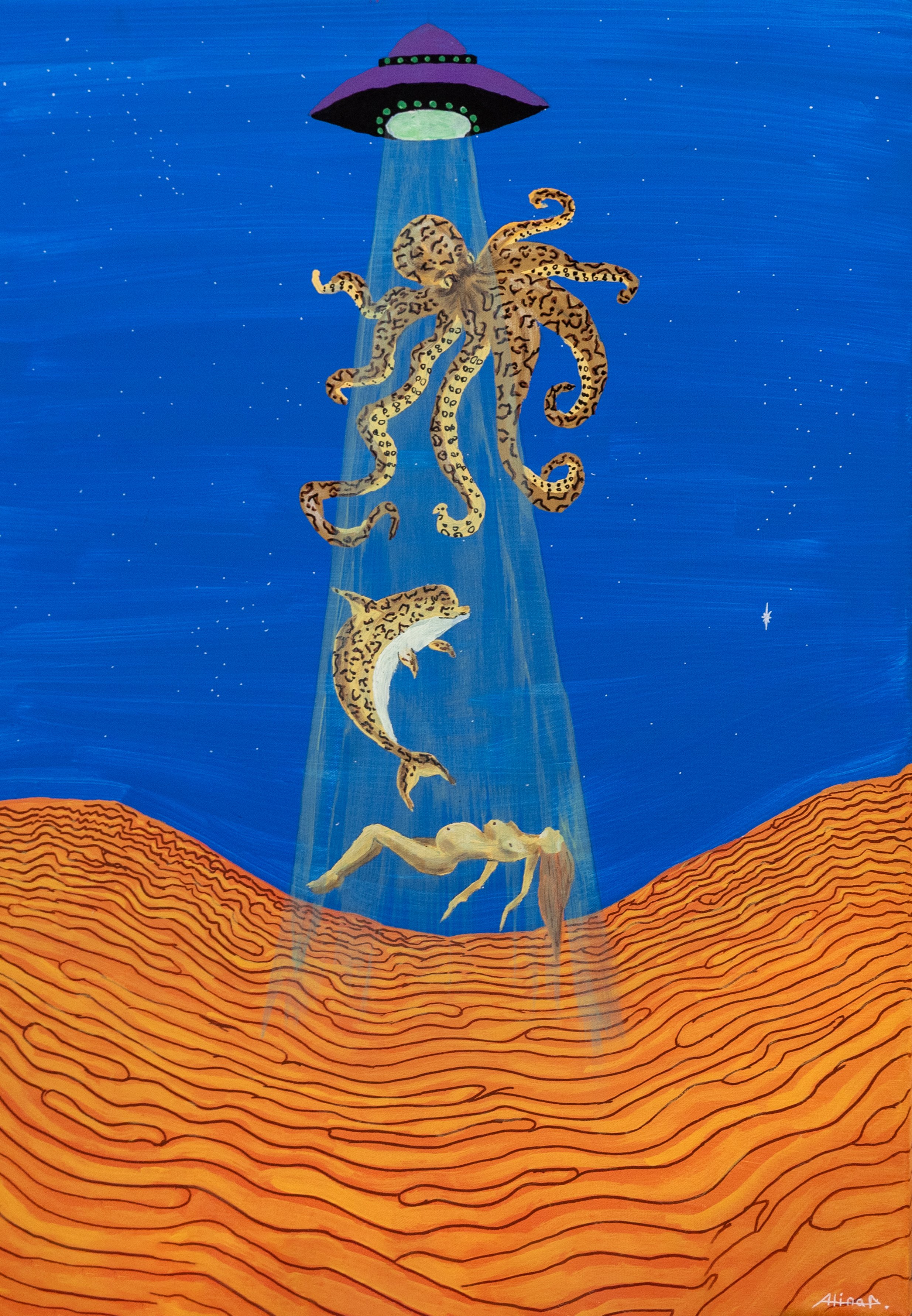
Trip Acrylic on canvas, 80 × 60 cm A miniature cosmic odyssey, Trip distills the grand narratives of Anti… into an intimate, kaleidoscopic vignette. Blending surrealism and cosmic pop, the work channels motion, discovery, and the unending voyage of consciousness. The UFO reappears as a playful emblem of transcendence — both transport and metaphor — while the fluid geometry of color evokes the sensory rush of crossing thresholds between worlds. Within this compressed space, humor meets existential wonder, capturing the artist’s fascination with travel not as escape but as evolution: each journey a rehearsal for transformation.
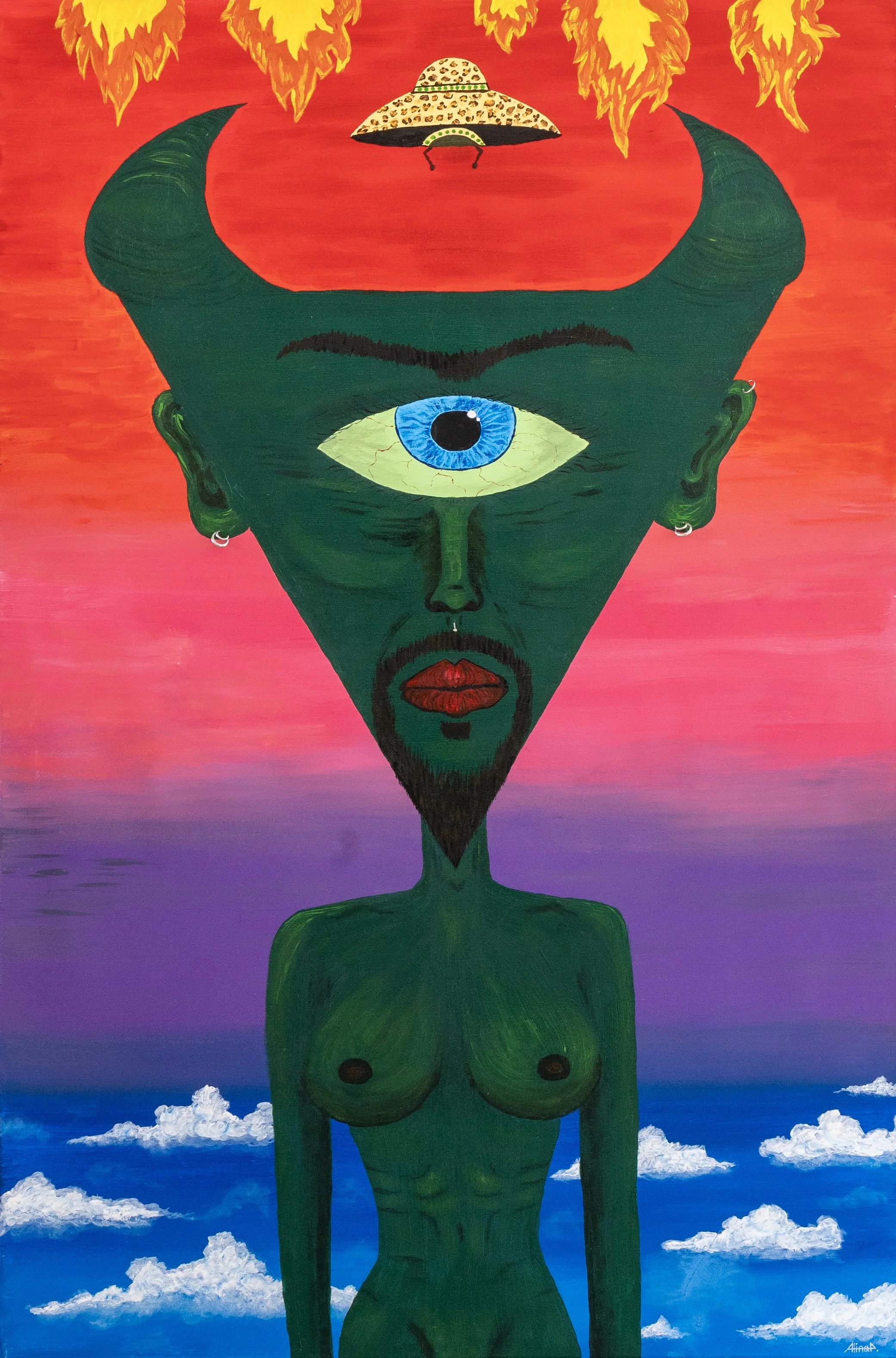
Me Acrylic on canvas, 150 × 100 cm Blending surrealism and pop iconography, Me portrays an androgynous, hermaphroditic being poised between divinity and rebellion, the human and the extraterrestrial. The coexistence of breasts and beard merges dual principles — the masculine (logic, power) and the feminine (intuition, fertility) — forming a unified vessel of creation and consciousness. Hovering above, the leopard-patterned UFO fuses animal instinct with technological transcendence, transforming nature into a symbol of evolution. The third eye (Ajna Chakra), derived from Eastern philosophy, opens as a point of higher perception — a reminder of our ability to see beyond appearance and illusion. Me becomes a self-portrait of modern humanity: reborn, hybrid, and self-aware. A being that carries within it the codes of all ages — technology, instinct, and divine consciousness — coexisting in one electrified form of becoming.
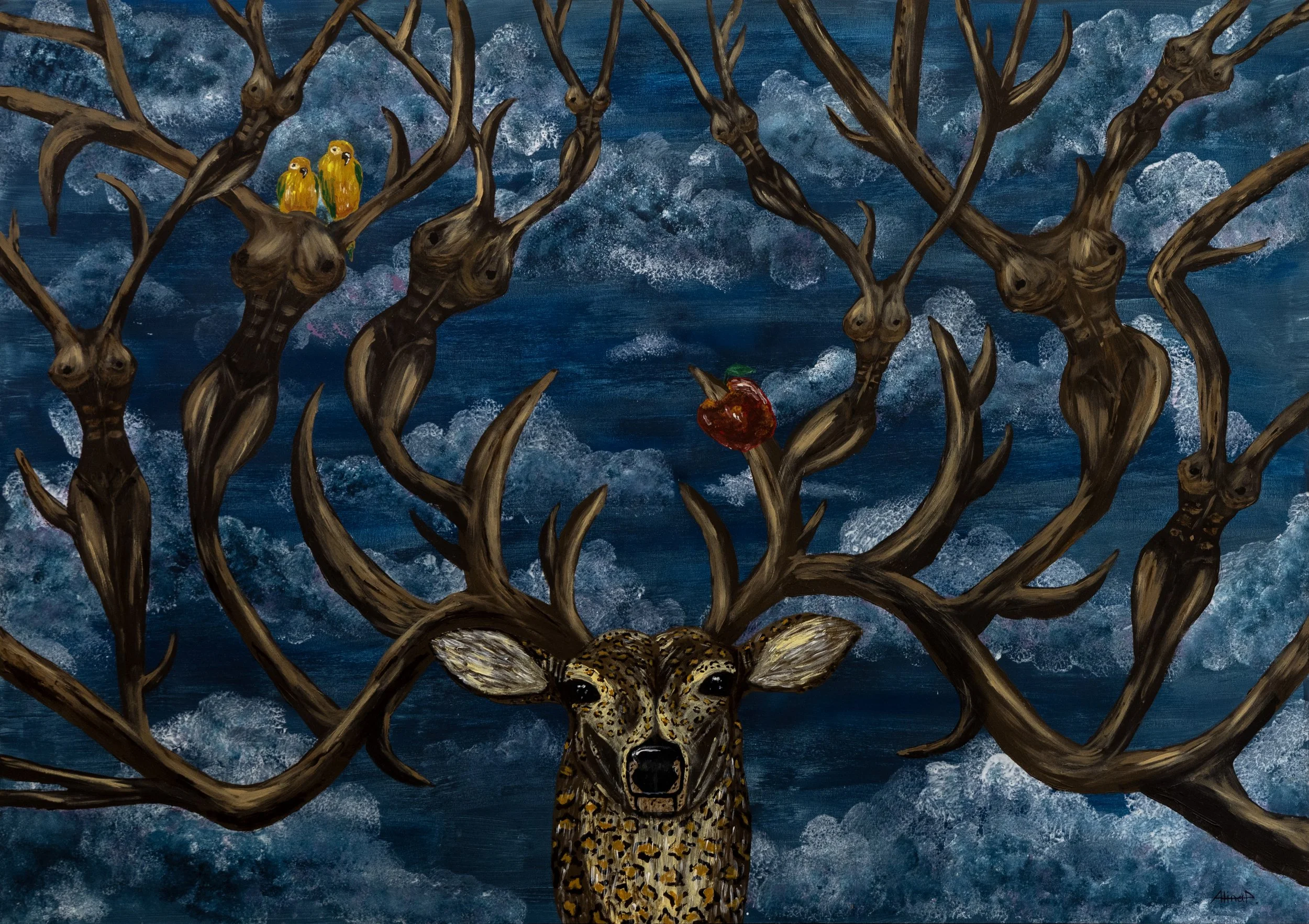
Woman (acrylic on canvas) 170x120 Surrealism The painting depicts a deer with imposing antlers that transform into human female forms — carriers of life and memory — a forest of bodies. The deer, traditionally a symbol of nobility, spiritual awakening, and rebirth, appears here as a mythical being that carries all of humanity on its antlers. Essentially, the work combines mythological and surrealist symbolism, turning the animal into a spiritual creator — a bearer of rebirth and feminine energy.